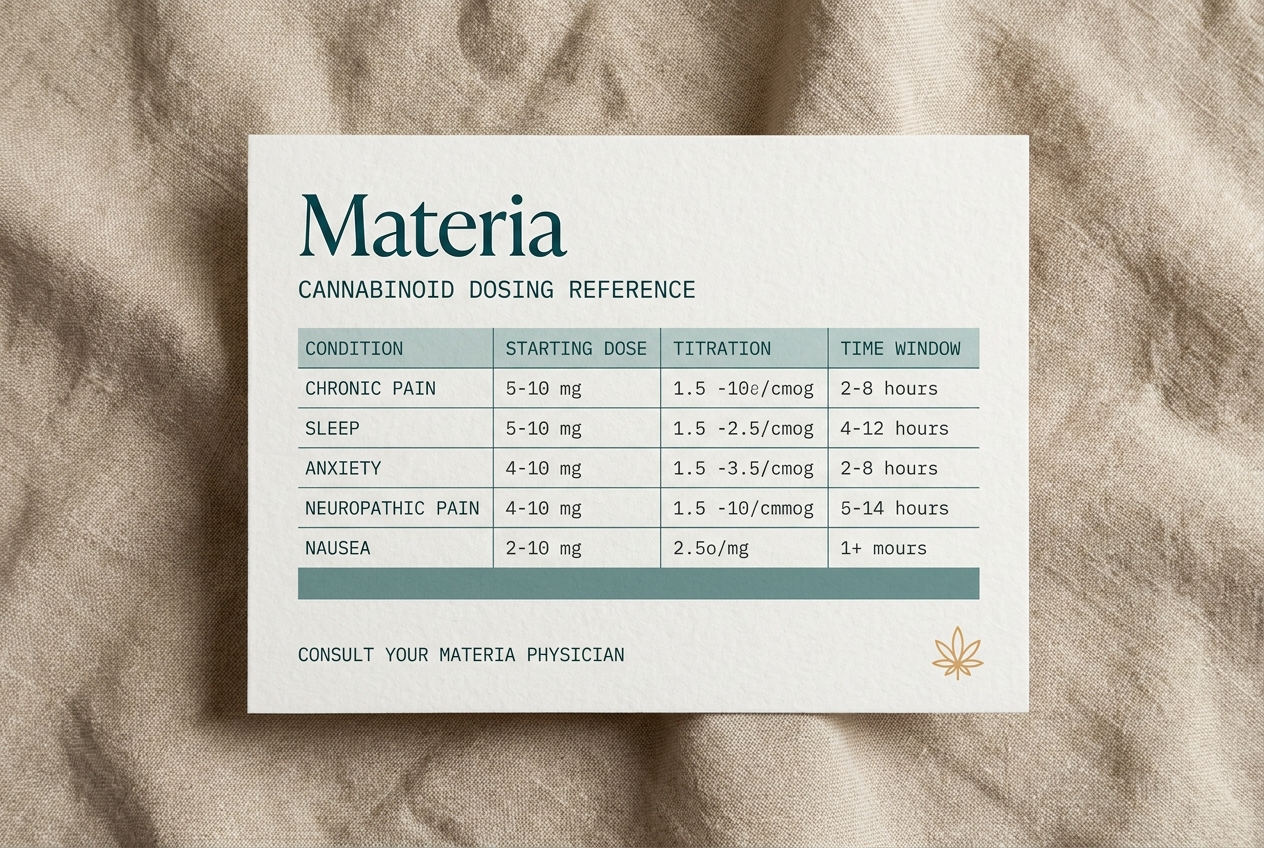
Five condition-specific programs · Evidence-led
Each program below carries an evidence-grade reflecting the current state of the literature. The grade is updated quarterly. Where the evidence is weak, we say so. Where another therapy has stronger evidence for your condition, we recommend that instead.
01 · Programs in detail
Program A
The program with the most consistent evidence base, particularly for neuropathic pain. Often offered as an adjunct to existing pain management rather than a replacement. Most patients in this program have already tried first-line therapies.
| Type | Starting dose | Titration | Window |
|---|---|---|---|
| THC-dominant | 2.5 mg | +2.5 mg / week | Evening |
| 1:1 THC:CBD | 5 mg | +5 mg / week | Twice daily |
| CBD-dominant | 20 mg | +10 mg / week | Three times daily |
Contraindication watch
Active substance-use disorder. History of psychosis. Concurrent use of high-dose opioids without coordinated tapering. Pregnancy.
Program B
The program with the strongest evidence base. Cannabis (and synthetic analogues) are well-studied for chemotherapy-induced nausea and have moderate evidence for cachexia and treatment-related sleep disturbance.
| Indication | Starting dose | Titration | Window |
|---|---|---|---|
| Nausea | 5 mg THC | +5 mg / 3 days | 30 min pre-chemo |
| Cachexia | 2.5 mg THC | +2.5 mg / week | Before meals |
| Sleep | 5 mg THC / 5 mg CBN | +2.5 / week | Evening |
Coordination required
All oncology-program care plans are shared with your treating oncologist on authorization. We coordinate around chemotherapy cycles and known drug interactions.
Program C
Cannabis for sleep is one of the most common patient requests and one of the most evidence-mixed indications. Often offered as a third- or fourth-line option after sleep hygiene, behavioral therapy, and other pharmacological options have been tried.
| Type | Starting dose | Titration | Window |
|---|---|---|---|
| THC + CBN | 5 mg / 5 mg | +2.5 mg / 2 weeks | 60 min pre-sleep |
| CBD-dominant | 30 mg | +10 mg / 2 weeks | Evening |
Caveat
Long-term cannabis use for sleep is associated with REM-sleep changes. Materia recommends periodic tapering and reassessment. This is discussed at every follow-up.
Program D
A program with a conservative posture. THC at higher doses can paradoxically increase anxiety in a subset of patients. CBD-dominant formulations are generally preferred, but the evidence for CBD in clinical anxiety is itself uneven.
| Type | Starting dose | Titration | Window |
|---|---|---|---|
| CBD-dominant | 20 mg | +10 mg / week | Twice daily |
| 1:20 THC:CBD | 1 mg : 20 mg | per response | Twice daily |
Important
Patients with a personal or family history of psychotic illness are not candidates for THC-containing formulations. CBD-only protocols may be considered with extra caution.
Program E
The neurological program is the practice’s most specialty-focused. Strongest evidence is for MS-related spasticity. Adult patients only — pediatric epilepsy cases are referred to specialty centers with established cannabidiol protocols.
| Indication | Starting dose | Titration | Window |
|---|---|---|---|
| MS spasticity | 2.5 mg THC / 2.5 mg CBD | +2.5 mg / week | Twice daily |
| Parkinson’s sleep | 5 mg THC + 5 mg CBN | +2.5 / 2 weeks | Evening |
Referrals out
Pediatric epilepsy cases are referred to UCSF’s pediatric epilepsy program. Materia does not see patients under 18.
02 · Who Materia will decline to treat
Materia is a medical practice with a defined scope. The following situations are outside that scope and the physician will decline to certify or will refer you elsewhere:
In every case where Materia declines, the physician will document the reasoning in the patient’s record and where appropriate, offer a referral.
Ready to book